Your AI Roadmap Has Too Many Pilots
"A long experiment list can hide a weak investment strategy. Make
The roadmap looks busy. There are assistants for meetings, agents for service requests, experiments in finance and a few ideas waiting for a sponsor.
At the executive table, the question is straightforward: which of these should receive the next dollar and the next month of the team's attention?
A pilot list rarely answers that well. It records activity. Investment decisions need a view of value, readiness, operating cost and the evidence still missing.
Give every experiment a decision to inform
A useful pilot should resolve an uncertainty. Can the system retrieve the right evidence? Can a team operate the workflow? Will the customer experience improve? Is there enough demand to justify the cost?
Those are different experiments. Each needs a clear decision at the end.
Before approving one, I would ask the sponsor to describe the business problem, the current baseline, the intended benefit, the uncertainty being tested and what result would justify proceeding. I would also ask what result would justify stopping.
Stopping criteria are particularly useful when the technology is interesting and the benefits remain vague.
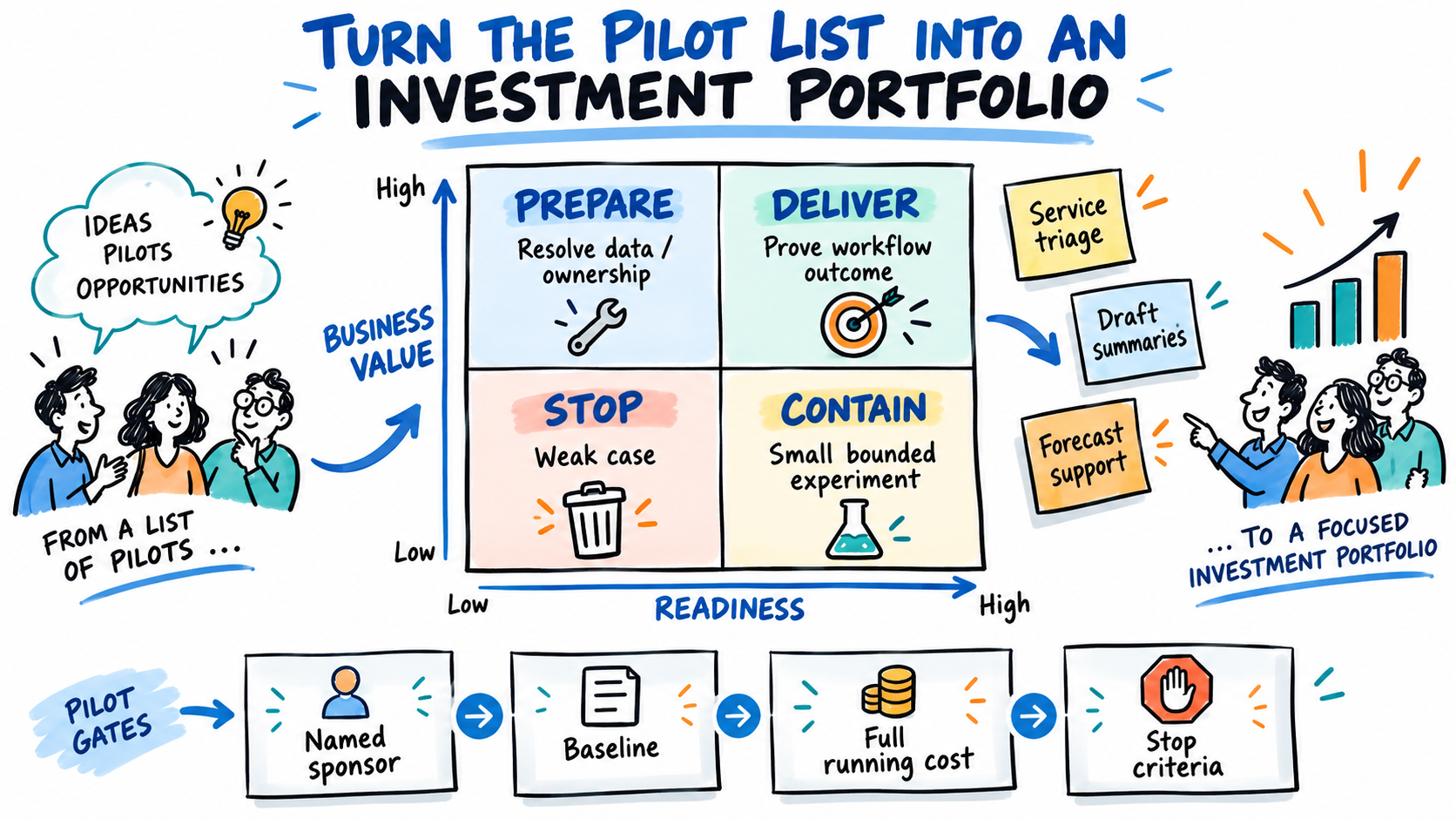
Use value and readiness to structure the conversation, then examine the evidence behind each position.
Separate a valuable idea from a ready investment
A high-value workflow may depend on unresolved data ownership or access problems. It could deserve preparation funding before delivery funding. A technically easy experiment may offer only a modest benefit and warrant a small, contained budget.
The matrix is a discussion aid. It should not disguise judgement as a precise score. Ask what evidence supports the expected value, what readiness problems matter and whether fixing them would help other workflows too.
Shared dependencies can change the sequence. Establishing a governed policy source may unlock several useful services. Funding five separate assistants around five unreliable copies could create more work than value.
Follow the benefit into the operating model
“Hours saved” needs another question: what will people do with that time?
A drafting assistant might reduce preparation effort while leaving the approval queue untouched. The team feels an improvement, but the end-to-end service takes just as long. Alternatively, the saved capacity might allow staff to handle a backlog or spend more time on difficult cases. That can be valuable, provided someone plans and measures it.
Trace a simple chain: AI capability, workflow change, measurable effect and business outcome. Name the owner who can make the workflow change happen.
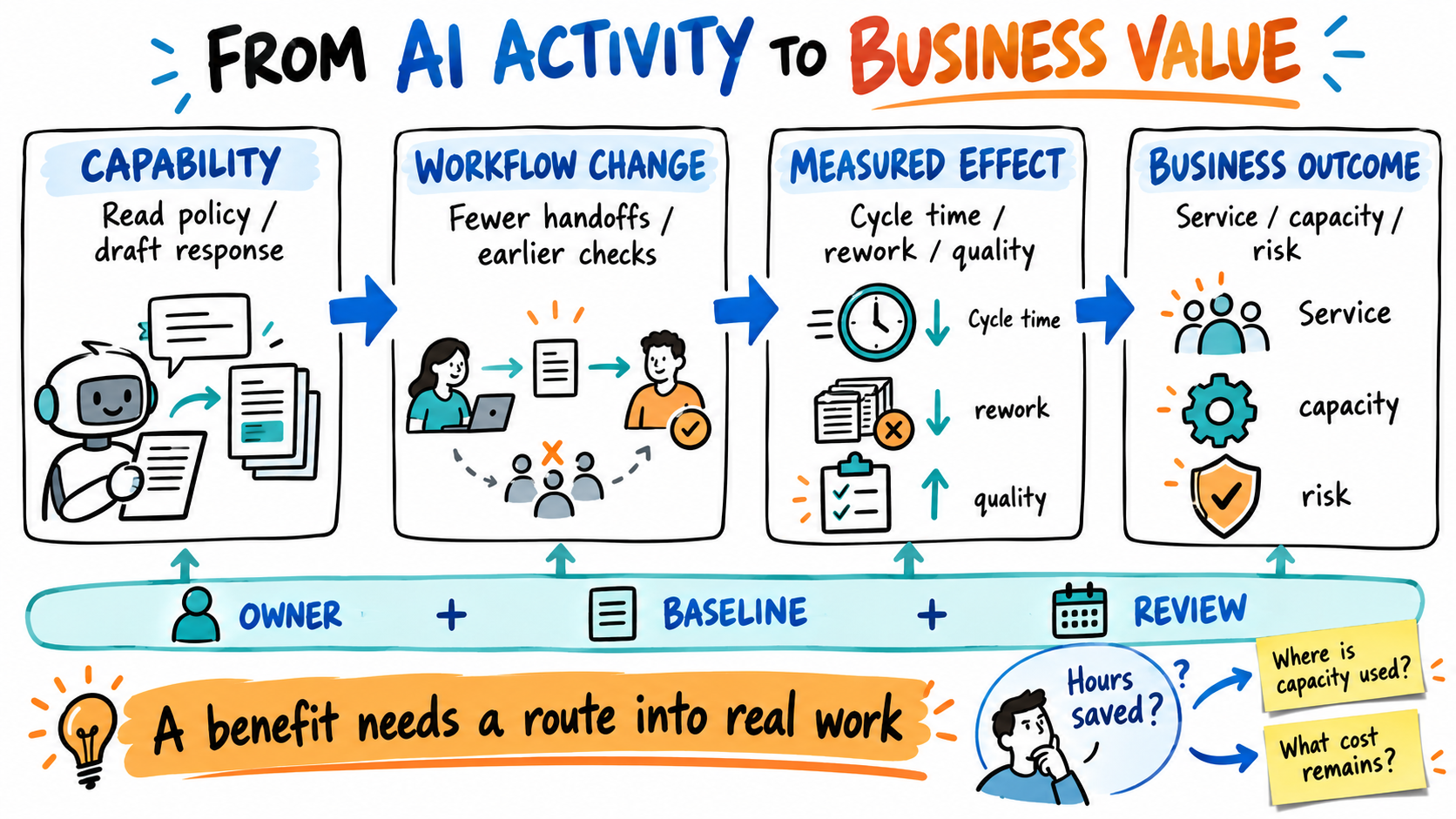
Connect technical capability to a change in work and a benefit the organisation can verify.
The cost side needs equal attention. Include integration, information preparation, evaluation, support, human review and ongoing change alongside licences and model consumption. A cheap demonstration can become an expensive service if every difficult case requires specialist intervention.
Review the portfolio with decisions attached
I would give each investment a clear next disposition: deliver, prepare, contain or stop. Record why, what evidence is required next and when the decision will be revisited.
Keep room for exploration. Some experiments are worth funding because they teach the organisation something important. Be explicit about that learning objective and limit the commitment accordingly.
At the next roadmap review, choose three pilots and ask which investment decision each will resolve. If nobody can say, reshape the experiment before adding another one to the list.