You Bought the Copilot. Who Redesigned the Work?
Licences and training create access to AI. Workflow ownership,
The licences are available. The training sessions are full. People are sharing useful prompts. The adoption dashboard is moving in the right direction.
A few months later, the business still has the same approval delays, repeated handoffs and unclear responsibilities.
This is a reasonable point to ask who was responsible for changing the work around the tool.
People can become individually more productive while the wider process barely moves. A faster draft still waits in the same queue. A better meeting summary still needs someone to turn the decision into an action.
Follow the work through the organisation
Choose a recurring workflow and walk it with the people who actually do it.
Where does it begin? What information is missing at the first handoff? Which checks prevent real harm? Which steps exist because two systems cannot exchange information? Where does someone wait for a decision that nobody clearly owns?
That conversation often identifies changes that should happen before AI is introduced. Removing a duplicate approval or clarifying a responsibility may improve the workflow immediately.
Then look at where AI can help: preparing evidence, interpreting unstructured material, drafting a response or highlighting an exception. Give each task a clear place in the redesigned workflow.
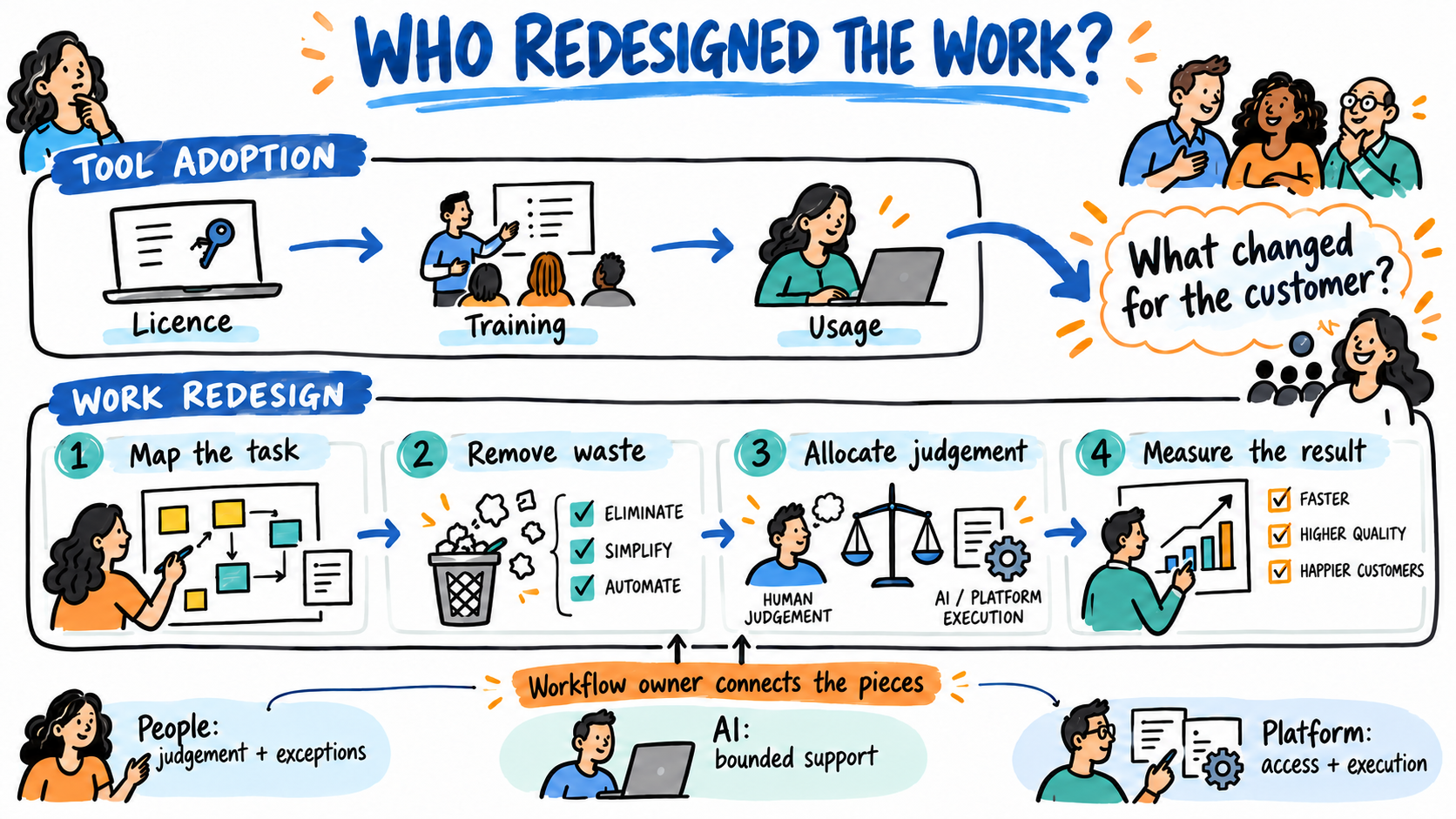
Connect adoption activity to workflow redesign and a result the customer or employee can experience.
Agree on the new responsibilities
A team needs more than permission to use an assistant. It needs to know what the assistant is expected to do, what the person must check and what to do when the output is uncertain.
For a service-response workflow, the AI might prepare a draft from approved guidance. The staff member verifies the case facts and handles the judgement. A governed service checks access and records the action. An exception goes to a named role with the information needed to resolve it.
Document this in plain language. It should be possible for a new team member to understand the handoff without reconstructing the implementation.
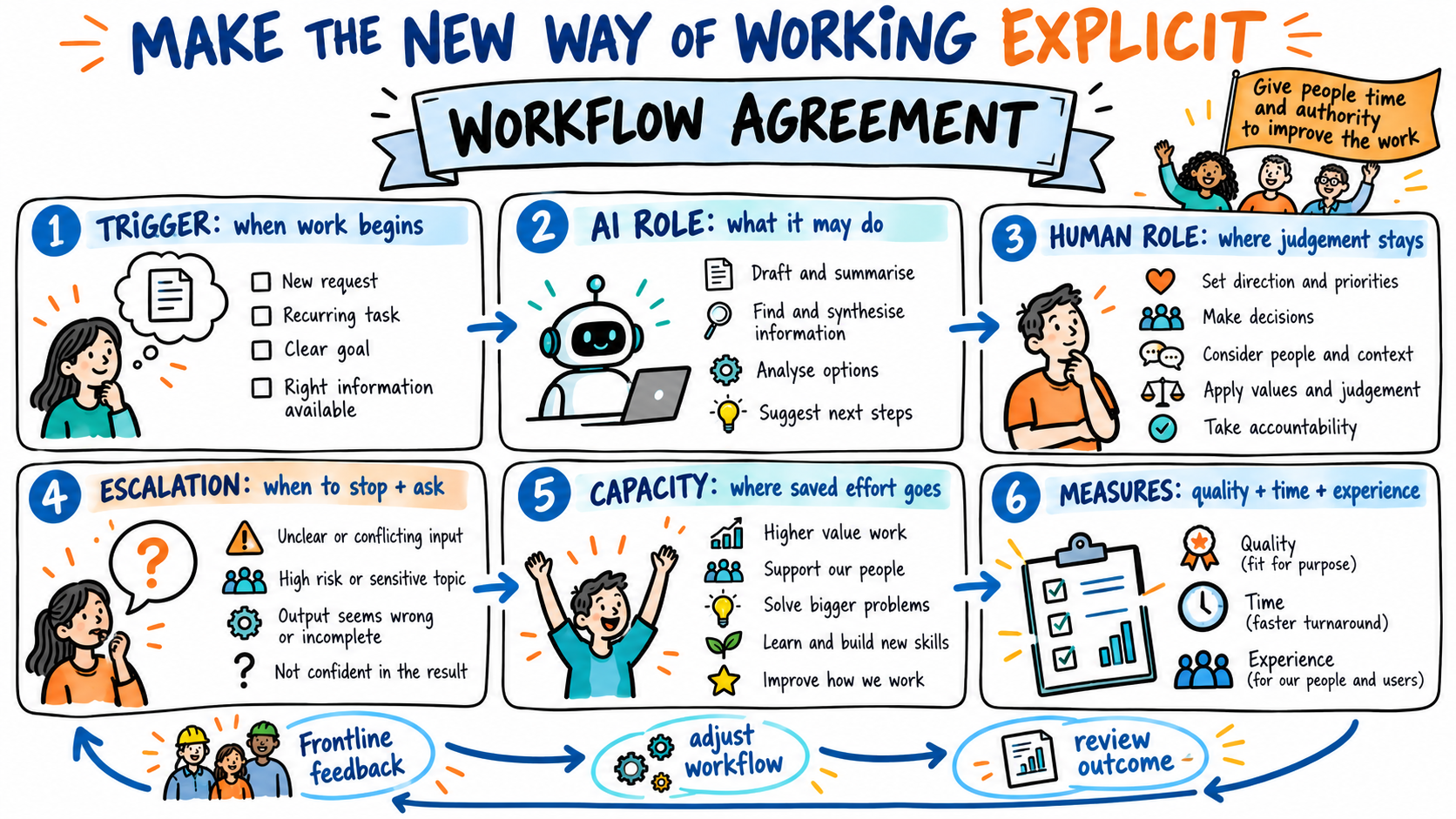
Agree on triggers, roles, escalation, capacity and measures with the people operating the workflow.
Give saved time somewhere to go
A productivity claim has practical consequences for people. If the organisation says AI will free capacity, it should explain how that capacity will be used and how workloads will change.
Perhaps the team will reduce a backlog, improve quality checks or spend more time with customers whose circumstances need care. Perhaps the process can absorb growth without adding equivalent effort. Those are choices for management to make openly and test with operating evidence.
Leaving that conversation vague invites uncertainty and makes benefits harder to realise.
Frontline staff also need time and authority to improve the workflow. Asking them to experiment on top of a full workload tends to produce uneven learning and workarounds that remain invisible to the organisation.
Measure the service after the tool arrives
Usage is useful adoption evidence. The business also needs measures of the changed work: completion time, avoidable rework, quality, customer effort and the handling of exceptions.
Microsoft's Frontier Firm research discusses changes in human-agent teams and organisational work. The practical question I take from it is who owns the whole workflow when responsibilities move between people and technology.
Start with one workflow owner, one agreed way of working and a baseline. Review the result with the team that lives with it. Their account of what improved, and what became harder, belongs beside the dashboard.